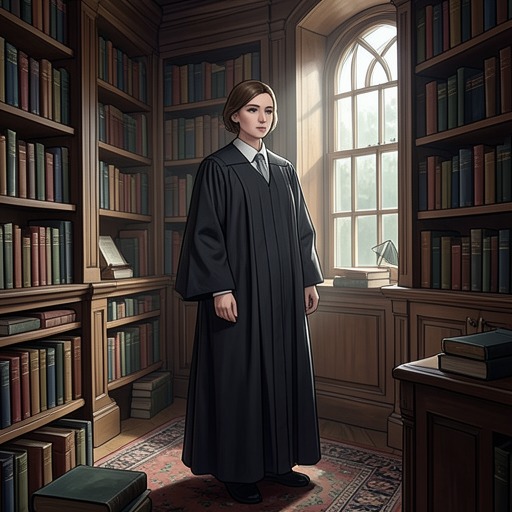
Marilla Cuthbert
Anne of the IslandMarilla Cuthbert is the stern, practical heart of Green Gables and the adoptive mother whose life is transformed by Anne Shirley’s arrival. She rarely makes a display of feeling, but the gestures that break through her reserve—a cheek-kiss at a departure, an embrace at a homecoming, a meal set before her returned daughter—reveal a tenderness more powerful for being restrained. Through Marilla, the story measures change not only by Anne’s years away, but by what Anne has made possible in the life of the person who stayed at home.
Identity and Inner Life
Marilla’s outward manner is angular, controlled, and sparing with emotion. Her reserve is not indifference: at Anne’s departure, she gives her a brisk kiss and says she supposes they will hear from her once she is settled. A casual observer might think the departure matters little to her, but a closer look at her eyes would tell another story. At a later homecoming, she is so afraid of crying with joy that she chooses to meet Anne in the shadows. Her feelings are real; she simply finds their public display uncomfortable.
The narration eventually opens a view into the long life behind that restraint. At sixty, Marilla thinks back on a cramped but not unhappy childhood, girlhood dreams kept jealously hidden, hopes that were blighted, and the long, narrow middle years that followed. Her past is not described as uniformly miserable, but it has been emotionally constrained. The contrast makes her later attachment to Anne more than a change of household: it is a new source of warmth and fullness in a life she had not expected to alter so greatly.
Anne’s Departure and the Meaning of Home
Before Anne leaves for college, the familiar rooms of Green Gables acquire the weight of impending loss. Anne recalls the spare room as a childhood shrine: the room’s stern portraits of George Whitefield and the Duke of Wellington, its uniquely undistorting mirror, and the awe with which she used to tiptoe through it. Marilla and Anne clear the room as Rachel Lynde is to move in. The room is not merely cleaned but stripped bare, and its old guardians are relegated to the upstairs hall. Anne laughs at the change while admitting regret; the altered room makes visible how even a home’s private landmarks pass out of their former use.
Anne’s own departure makes that sense of change more painful. At breakfast, Davy Keith cries over his porridge, while Dora Keith remains composed enough to eat his share. Rachel Lynde embraces Anne and warns her to take care of her health. Marilla, by contrast, keeps the farewell brief and tearless, though her eyes betray her. Davy cannot bring himself to say goodbye: when Anne approaches, he runs upstairs and hides in a clothes closet, and his muffled howls are the last sounds she hears as she leaves Green Gables. Marilla’s restrained farewell belongs to this household’s larger, uneven display of grief: affection is present, but no two people express it alike.
The Work of Care
Marilla’s care often takes practical form. When Anne returns unexpectedly from Carmody, having walked home a day early because she suddenly felt homesick, Marilla’s first response is an uncharacteristic embrace. She catches Anne in her arms, presses her and the flowers she carries against her heart, and kisses her bright hair and face. Then she tells her to sit down because she must be tired and sets about getting supper. The movement from spontaneous affection to immediate hospitality suits Marilla: love is expressed in touch, food, and attention to what the person before her needs.
The homecoming supper gathers other signs of that care. Rachel Lynde is there, Anne’s friends and family welcome her, and the rosebud tea set appears on the table. Marilla’s welcome is surrounded by the familiar people and objects that make Green Gables home again. Anne later says that Redmond College was splendid and Bolingbroke delightful, but Green Gables is home. Marilla does not need to compete with the places Anne has seen; her house remains the place to which Anne longs to return.
Marilla’s care also includes caution. When Anne spends many summer evenings with the increasingly frail Ruby Gillis, Rachel Lynde complains that Anne may catch consumption, and Marilla is doubtful too. The evidence presents her concern as practical rather than as a rejection of Anne’s loyalty. Anne has given up a moonlight drive to White Sands to keep Ruby company, even when the visits are difficult; Marilla’s hesitation places that devotion alongside the risks others believe it carries.
Change Through Anne
Nine years after Anne’s arrival, Marilla looks little changed in outline, but the narration marks a substantial softening. She is thinner and more angular, with more gray in her hair, still twisted into the same hard knot and held by two hairpins. Yet her mouth has developed a stronger suggestion of humor, her eyes are gentler, and her smile comes more often and with greater tenderness. The details retain the recognizable Marilla while showing change in the face through which she meets the world.
Marilla herself measures that change against Anne’s influence. She thinks of Anne as a vivid, imaginative, impetuous child who brought a loving heart and a world of fancy into the household. In her memory, the wilderness of existence blossomed. Looking back over sixty years, Marilla feels that she has truly lived only the nine years since Anne came. This is not a claim that the earlier years did not happen; it is a measure of how completely companionship and affection have altered their meaning. The adoptive bond has changed both the daughter who leaves and the mother who waits.
Reserve, Humor, and Narrative Significance
Marilla’s emotion repeatedly surfaces through small breaches in her own discipline. After Anne and Diana Barry go upstairs, she sarcastically predicts that they will talk all night; the narration observes that Marilla is always sarcastic after betraying herself. The joke makes her reserve legible without reducing it to coldness. Her sarcasm is a cover for tenderness, and her practical habits provide a language for feelings she finds difficult to state directly.
Her response to Miss Josephine Barry’s death shows the same plainness. When Anne reads the news and sits with tears in her eyes, Marilla asks what is wrong. On hearing that Miss Josephine has died, Marilla remarks that she has been ill for over a year, that the family expected the news, and that she is at rest after dreadful suffering. She adds that Miss Josephine was always kind to Anne. The words are matter-of-fact, but they acknowledge both the dead woman’s pain and her place in Anne’s life.
Marilla’s significance lies in this gradual revelation of feeling beneath familiar austerity. She is not remade into an openly demonstrative person: she remains angular, sarcastic, and practical. What changes is the tenderness visible in those traits and the life they serve. Anne’s departures make the cost of separation visible; her returns show the enduring force of Green Gables and of the attachment Marilla has helped create. The home is a refuge for Anne, but it is also the setting in which Marilla’s own life blossoms.